When Your Catholic Marriage Becomes Interfaith: Navigating Faith Differences
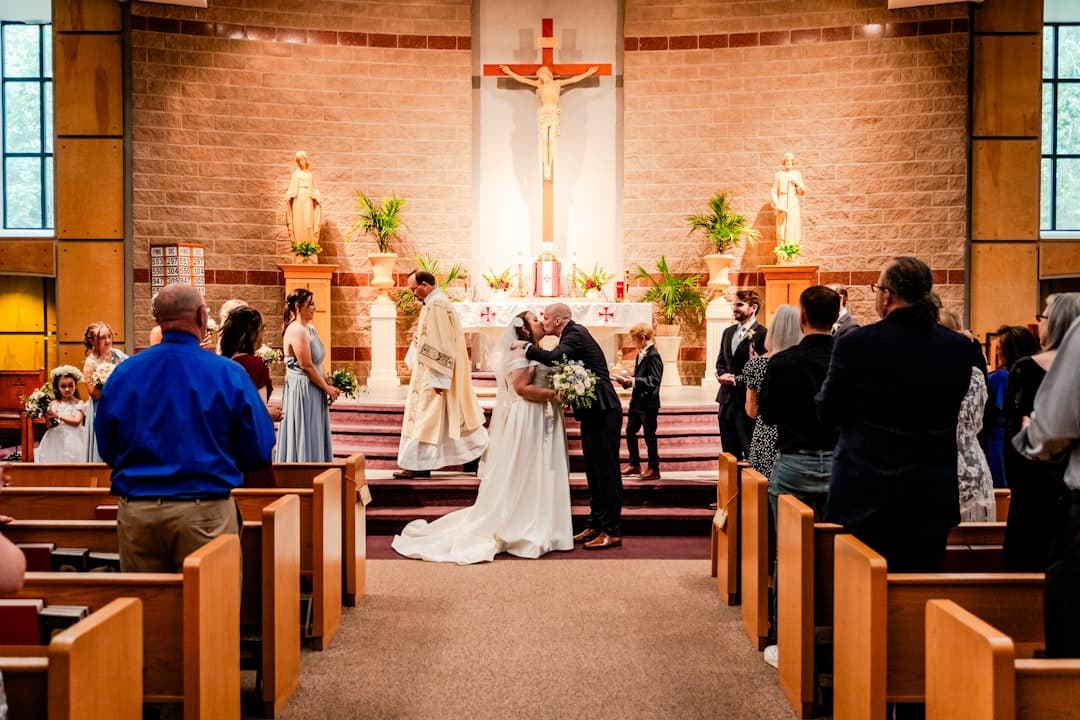
Photo by Kari Bjorn Photography
Something has shifted. Maybe it happened during confession booth, when a practice you've done a thousand times suddenly felt hollow. Maybe it crept in slowly, one unanswered question at a time, until the accumulated weight became impossible to ignore. Either way, you're carrying something now that you didn't choose to pick up.
That weight is real. And you're not the first person to carry it.
How Are Your Relationships Changing?
What you're experiencing is real, and it's more common than anyone around you is likely to acknowledge. A marriage built on shared faith can survive a faith change, but it requires renegotiating assumptions neither of you knew you had. Naming this is not the end of the process, but it is the beginning.
The Catholic world taught you that Catholic identity was who you are, not just what you believe. When that identity cracks, you're not just revising a theological position. You're losing a self-concept that organized everything from your daily routine to your deepest relationships.
The nighttime hours are often the worst. During the day, distraction helps. But at 2 AM, when the confessional voice cataloguing your sins shows up, there's nowhere to hide. If this is happening to you, know that it's incredibly common, it's not a sign that your doubt is wrong, and it does get less frequent over time.
You may be testing each question against the fear of what happens if the answer is what you suspect. That fear, of hell, of family rejection, of identity collapse, is not irrational. It's the predictable result of a system that taught you that questioning leads to catastrophe. But millions of people have followed these questions and survived. Many of them would tell you the other side of questioning is not catastrophe. It's clarity. You don't have to justify this process to anyone, not even yourself.
What About Your Marriage?
Faith transition puts pressure on a marriage that neither of you signed up for. The vows you made assumed a shared theological foundation, and that foundation has shifted. This doesn't mean the marriage is over, but it does mean the marriage has to change, and that change requires honest conversation, not silence.
In Catholicism, doubt is rarely treated as a healthy part of growth. It's framed as a danger, a test, or a failure. That framing makes it nearly impossible to question openly, which forces the questioning underground, where it festers in isolation, disconnected from the support you'd need to navigate it well.
Many people who've been through this describe a period of emotional whiplash, relief and grief, freedom and fear, anger and tenderness, all arriving without warning. If that's your experience, you're not unstable. You're in the middle of something enormous, and your emotional system is doing exactly what it should: responding to the full reality of what's happening.
The questioning itself is not the problem, even though your tradition probably framed it that way. Doubt was treated as a spiritual failure, a test to overcome, a weakness to confess. But doubt is also how people grow. The fact that you're asking questions doesn't mean something is wrong with you. It might mean something is finally working. You don't have to be sure about anything to deserve support.
You're Not the First Person to Think This
Millions of people have sat exactly where you're sitting. They've stared at the same ceiling at 2 AM, carried the same questions to the same Mass, and felt the same terrifying loneliness of doubting something everyone around them treats as settled. You are not an anomaly. You are not broken. You are part of a pattern as old as organized religion itself.
Inside Catholicism, the entire social architecture is built on shared belief. parish festival isn't just a tradition, it's a trust signal, a belonging marker, a way of saying "I'm one of us." When your relationship to that shifts, the architecture doesn't just feel different. It becomes structurally different, because it was designed to function on consensus.
Anger is often the emotion people feel most guilty about, because most religious traditions teach that anger is sinful or dangerous. But anger at genuine harm is not only appropriate, it's a sign that your sense of self-worth is intact. You're angry because you were treated in ways that weren't okay. That clarity is a foundation you can build on.
There's a stage in questioning where you know you can't go back but you can't see what's ahead. It's like standing in a dark hallway between two rooms. The room behind you is lit and familiar, but the door has locked. The room ahead of you is dark. This hallway stage is uncomfortable, and it's temporary. You're not stuck. You're in transit. You're allowed to take this at your own pace.
What Happens if You Say It Out Loud?
There's power in speaking a doubt out loud, and there's also risk. Inside Catholicism, voicing doubt can trigger the community's immune response, well-meaning interventions, increased scrutiny, strained relationships. Before you say anything to anyone, ask: is this person safe? Do they have a track record of sitting with hard things without trying to fix them?
The being told to come back for the sacraments is one of the most painful dimensions of this transition. Your family isn't trying to hurt you. They're operating from the same framework you were given, one that tells them your soul is at stake. Their fear is real, even when their response is harmful.
There's a particular loneliness that comes with this kind of grief. The people who would normally comfort you are often the people you're grieving. The parish that would normally hold you is the community you're stepping away from. That double bind, needing support while losing your support system, is one of the cruelest features of religious transition.
You may be testing each question against the fear of what happens if the answer is what you suspect. That fear, of hell, of family rejection, of identity collapse, is not irrational. It's the predictable result of a system that taught you that questioning leads to catastrophe. But millions of people have followed these questions and survived. Many of them would tell you the other side of questioning is not catastrophe. It's clarity. It's okay to not have this figured out.
How Long Can You Carry This Alone?
The isolation of carrying religious doubt in secret is genuinely damaging. The cognitive load of maintaining a public faith while privately questioning it drains energy you need for everything else in your life. You deserve at least one person, a therapist, a friend outside the community, an online peer, who knows the truth of what you're carrying.
Many people who've navigated this transition from Catholicism describe the same paradox: the Eucharistic adoration that once felt like home now feels like a performance, but the absence of it feels like nothing at all. That gap between performance and absence is where much of the disorientation lives.
Notice where in your body you feel the heaviest right now. Place your hand there, if you want. You don't have to do anything about it. The part of you that learned to be small, to not make waves, to perform certainty for other people's comfort, that part had a job once, and it did it well. It kept you safe inside a system that required compliance. But you're in a different place now, and that protective part doesn't always know it yet. Be gentle with it. It's working from old information.
You may be testing each question against the fear of what happens if the answer is what you suspect. That fear, of hell, of family rejection, of identity collapse, is not irrational. It's the predictable result of a system that taught you that questioning leads to catastrophe. But millions of people have followed these questions and survived. Many of them would tell you the other side of questioning is not catastrophe. It's clarity. There is no wrong way to navigate this.
You Don't Have to Navigate This Alone
If the weight of everything you're carrying right now feels like too much for one person, that feeling is telling you something worth listening to. You were never meant to navigate this alone, even though the nature of this transition often strips away the very support systems you'd normally rely on.
A therapist who understands religious transition can provide support that friends and family, however well-meaning, often cannot. You don't have to be in crisis to reach out. You don't have to have your story figured out.
There is no right timeline for any of this. There is no correct sequence of steps, no checklist to complete, no milestone that marks "done." You are allowed to take this at whatever pace makes sense for your life, and whatever you're feeling right now, the grief, the anger, the relief, the confusion, all of it tangled together, is the appropriate response to something genuinely significant.
Share this article
Your Next Steps
Try This
- Write down one thing that has changed in how you and your spouse talk about faith, not to fix it, just to name it clearly for yourself.
- Choose one upcoming moment (a meal, a Sunday morning, a holiday) where faith differences might surface, and decide in advance what you actually want from that conversation.
- Reach out to one person, a friend, a therapist, or an online community, who has navigated a mixed-faith marriage and ask them one honest question.
Keep Reading
Explore Resources
A Moment to Reflect
It's okay if you don't know yet whether your faith is shifting permanently or just changing shape, you don't have to have that answer before you can talk honestly with your spouse.
You might notice that the hardest part isn't the theological difference itself, but the fear of what it means for the life you built together. That fear makes sense.
What would it feel like to have one conversation with your partner where neither of you tried to resolve anything, just to say out loud what you're each actually carrying?
Stay connected
A monthly letter with new articles, book recommendations, and quiet resources. Just an email address — unsubscribe anytime.