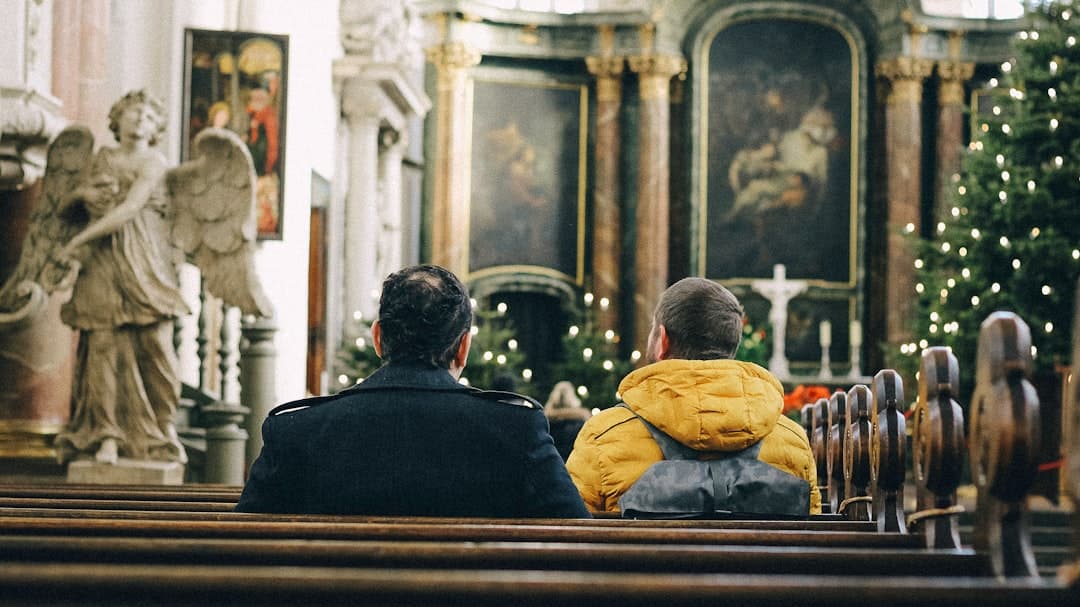
They Were Confirmed, Married in the Church, Baptized Their Kids, And Now They Are Leaving
Photo by Vladislav Anchuk
You noticed the change before they said anything. The missed Mass, the quiet during prayer, the way they changed the subject when you mentioned something about parish. You know. And you're carrying your own grief about it, probably in silence.
Your feelings about this are as real as theirs.
Who Are You Becoming?
What your loved one is going through has a name and a pattern, even if it doesn't feel that way from the outside. Every sacrament they received was real to them at the time; their leaving does not retroactively invalidate those experiences or your shared history. Understanding this is the first step toward supporting them without losing yourself in the process.
The cultural identity entanglement you may be experiencing isn't a personal failure. It's the predictable consequence of a system that tied your sense of the Eucharist directly to your participation in Catholicism. When that participation changes, the loss is real and proportionate to what was at stake.
Your loved one is probably watching you more closely than you realize. They're looking for evidence that honesty is safe, that being real about where they are won't cost them the relationship. Every interaction is a data point. When you show up with curiosity instead of judgment, you're writing proof that love is bigger than agreement. It's okay to rest in the middle of this. Not everything requires forward motion.
Who Are You Without This?
You are not starting from zero, even though it feels that way. The person you were inside Catholicism was genuinely you, shaped by context, constrained in some ways, but not a fabrication. What's happening now is not unmasking. It's evolution. And evolution is slow, nonlinear, and uncomfortable in the middle.
The being told to come back for the sacraments is one of the most painful dimensions of this transition. Your family isn't trying to hurt you. They're operating from the same framework you were given, one that tells them your soul is at stake. Their fear is real, even when their response is harmful.
Find your own support. You need someone to talk to about what you're going through, and that person should not be the one who is deconstructing. A therapist, a trusted friend, a support group for families navigating faith transitions, these resources exist and using them isn't weakness. You're not behind schedule. There is no schedule.
What Not to Say (and What to Say Instead)
The things that feel most natural to say are often the things that cause the most damage. "I'll pray for you," "Have you talked to priest?", "Are you sure this isn't just a phase?", "You'll regret this", each of these feels like love to the person saying it and feels like a closing door to the person hearing it. What helps more: "I love you, and that hasn't changed."
What makes this particular to Catholicism is the totality of what's involved. This isn't just a change in Sunday morning plans. The parish organized your social life, your moral framework, your sense of where you stand in the universe, and often your closest relationships. When you question one piece, the rest trembles.
Notice the difference between expressing your feelings and making your feelings your loved one's responsibility. You're allowed to be sad, confused, even angry. But when those feelings become leverage, "You're tearing this family apart," "How could you do this to me?", you've crossed from expression into manipulation, even if you don't mean to. Find spaces to process your own emotions that don't burden the person who is already carrying so much.
Taking Care of Yourself Through This
Supporting someone through a faith transition is exhausting work, especially when your own faith is part of your identity. You're allowed to need help too. A therapist who understands religious dynamics can help you process your own experience without it bleeding into your relationship with the person you're supporting.
Whatever happens with your loved one's faith, your relationship with them is not over unless someone decides it is. Many families find their way to a new normal, different from what they imagined, but genuinely good. That possibility is real, and it's worth the difficult work of staying connected.
Your love brought you here. That matters more than you know.
Share this article
Your Next Steps
Try This
- Write down one thing you wish you could say to your loved one about their departure, not to send, just to acknowledge what you're carrying.
- Choose one conversation this week where you ask a question instead of offering a response, something like 'What has this been like for you?' and then just listen.
- Identify one person in your own life you can talk to honestly about your grief around this, someone who won't need you to manage their reaction too.
Keep Reading
Explore Resources
A Moment to Reflect
It's okay to grieve this without knowing exactly what you're grieving, the loss of shared ritual, a future you imagined, or a version of them that felt familiar.
You might notice that your feelings about their leaving aren't all the same, some moments there's sadness, others frustration, others something closer to understanding. All of that can be true at once.
What would it feel like to be curious about who they are becoming, rather than focused on what they are leaving behind?
Stay connected
A monthly letter with new articles, book recommendations, and quiet resources. Just an email address — unsubscribe anytime.